
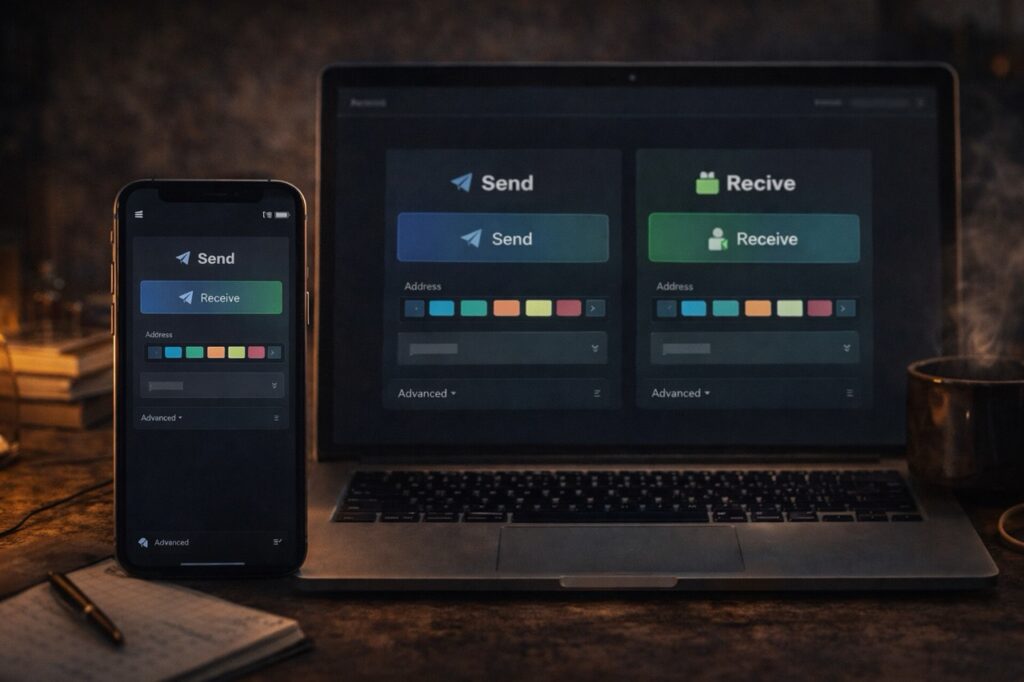

The second founding member arrived, looked at the wallet, and exposed my blind spot in under five minutes.
The wallet worked. It was functional. It was honest. It was also built by me, which means it was built by a protocol engineer. Protocol engineers design interfaces the way they design APIs: “If the user is careful, they will be fine.” Real users are not careful. They are human. They are tired, distracted, and sometimes scared. A wallet is not a UI. It is a safety system.
The Architect of Experience has designed products used by millions. They also walked away from a world where “UX” increasingly meant manipulation. Dark patterns. Engagement traps. Interfaces optimized for addiction. They refuse that work. They came here because ZooBC is explicitly trying to build the opposite: tools that respect the user.
They started with the most dangerous failure mode: sending to the wrong address.
We implemented visual address verification, making address type and critical segments easier to compare at a glance. The goal is not decoration. The goal is reducing the probability of irreversible mistakes.
Then they redesigned the flow around progressive disclosure. A new user should see the simplest possible surface: send, receive, and basic status. Advanced features are still there, but they do not compete for attention. Escrow, multisig, node registration, message attachment, fee voting: these reveal themselves as users show intent. The wallet stops being a cockpit and becomes a doorway.
They also made the trust model visible. Escrow is not “a form.” It is a relationship. The UI must show who holds the funds, who can release them, what timeout means, what happens if the counterparty disappears. If you cannot understand the trust model without reading docs, the interface failed.
Then we reached the controversial decision, and I agreed with them immediately: no transaction history by default.
A wallet is not a bank. It should not become a silent surveillance tool. If a user wants history, they can connect intentionally to an archival node, and the wallet will show it with clear disclosure. But the default is privacy. Not because privacy is a slogan, but because it is the only sane default for a tool that holds keys.
Watching this happen changed the project more than I expected. Good design is not just aesthetics. It is ethics embedded in interaction. It forces you to ask: are we making the correct action the easiest action? Are we reducing irreversible mistakes? Are we respecting the user’s right to not be tracked?
ZooBC is a protocol, but it is also a promise. The Architect is now one of the people making sure that promise survives contact with real humans.