
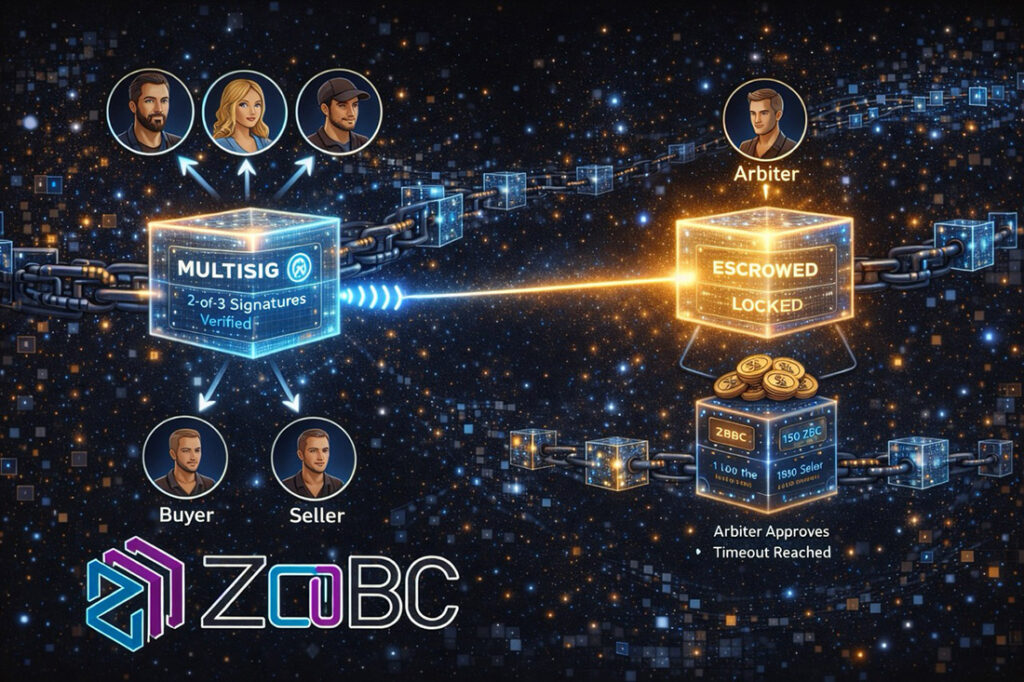

This week, I work on something that goes beyond protocol mechanics.
Speed, consensus, and cryptography are necessary, but they are not enough. If ZooBC is going to be useful in the real world, it needs ways for people to trust each other without trusting blindly. That is where multisignature transactions and escrowed payments come in.
These are not smart contracts. There is no scripting language, no virtual machine, no arbitrary code execution. They are native blockchain features, built directly into the protocol, designed to solve very specific trust problems with as little complexity as possible.
Sometimes, less really is more.
Multisignature: Shared Control Without Fragility
Multisignature transactions are conceptually simple, and that is part of their strength.
Instead of a transaction being authorized by a single private key, it can require multiple signatures from different accounts. Funds only move when enough parties agree. Lose one key, and the system does not collapse. Compromise one signer, and nothing happens.
The C++ implementation supports flexible N-of-M multisignature structures. Any N signatures from a defined set of M authorized accounts can authorize a transaction. This makes it possible to model real-world situations naturally: corporate accounts, partnerships, joint custody, treasury controls.
What makes ZooBC’s approach interesting is where enforcement happens.
Multisignature rules can be enforced directly at the blockchain level for maximum security. Validation happens as part of the transaction processing pipeline, not as an add-on. Signatures are checked deterministically, and every node reaches the same conclusion.
At the same time, the design allows for off-chain coordination when efficiency matters. Parties can collect signatures outside the chain and submit a fully authorized transaction once everything is ready. The blockchain does not care how signatures were gathered, only that they are valid.
Fast. Deterministic. Predictable.
Escrow: Trust With an Exit Strategy
Escrowed transactions solve a different problem.
In many exchanges, neither party wants to move first. One side fears not being paid. The other fears not receiving what was promised. Traditionally, this requires a trusted intermediary.
ZooBC’s escrow mechanism removes that requirement.
Funds can be locked on-chain under explicit conditions. An escrow transaction specifies a recipient, an optional arbiter, a timeout, and the rules for release. Until those conditions are met, the funds cannot move.
If everything goes well, the recipient receives the funds.
If there is a dispute, the arbiter decides.
If nothing happens, the timeout ensures the funds are eventually released back.
No one is stuck forever.
State That Cannot Lie
Implementing these features correctly requires careful state management.
Each multisignature configuration and each escrow agreement has its own on-chain representation. This state is explicit, versioned, and validated by every node. There is no hidden logic and no implicit assumptions.
For multisig, the C++ code verifies each signature cryptographically and checks that the required threshold is met. Order does not matter. Duplication does not help. Partial authorization never leaks through.
For escrow, timeout conditions are evaluated deterministically based on block height and timestamps. Arbiter approvals are checked the same way as any other signature. Every node executes the same logic and reaches the same result.
No interpretation.
No discretion.
No surprises.
Practical Trust, Not Abstract Power
What I like most about these mechanisms is what they do not introduce.
No scripting language to secure.
No gas model to tune.
No runtime that can be abused in unexpected ways.
Multisig and escrow are boring by design. They solve common, real problems with fixed, auditable rules. That makes them easier to reason about, easier to test, and harder to exploit.
They also unlock real use cases:
- Secure corporate and organizational accounts
- Conditional payments for goods and services
- Built-in dispute resolution without third parties
- Shared custody without operational fragility
Sitting in my lab, testing these flows end to end, I feel a familiar sense of quiet satisfaction. This is the kind of infrastructure that disappears into the background and simply works.
Not everything needs to be programmable.
Sometimes, the right primitives are enough.