

A blockchain nobody can see is a blockchain nobody can trust.
That sounds obvious, but many projects forget it because they treat explorers as “nice to have.” I treat it as a prerequisite. ZooBC makes a public claim: “this is what happened, and you can verify it.” If the only way to verify is by trusting me, trusting my nodes, or trusting a private API, the entire point collapses.
So this week I built the first public block explorer for ZooBC, and I built it with the same philosophy as the wallet: static, serverless, and honest.
It is a simple web application, served as static files. No backend. No accounts. No sessions. No tracking. No analytics. Just a window into the chain. It connects to archival nodes via the gateway and renders what the network is doing right now: blocks, timestamps, producers, transaction counts, and confirmation depth. It renders transactions with their types and intent, not just raw hashes. It renders accounts with balances and activity. It renders the node registry with participation scores and locked balances, because in Proof of Participation those are the health metrics that matter.
The explorer is built on top of earlier work that was easy to underestimate at the time: the archival API surface, the fork detection logic, and the live observation layer. The TOI stream is what makes the explorer feel alive. New blocks appear without refresh. Transactions move from mempool to confirmed with visible state transitions. It is not “a chart.” It is observability.
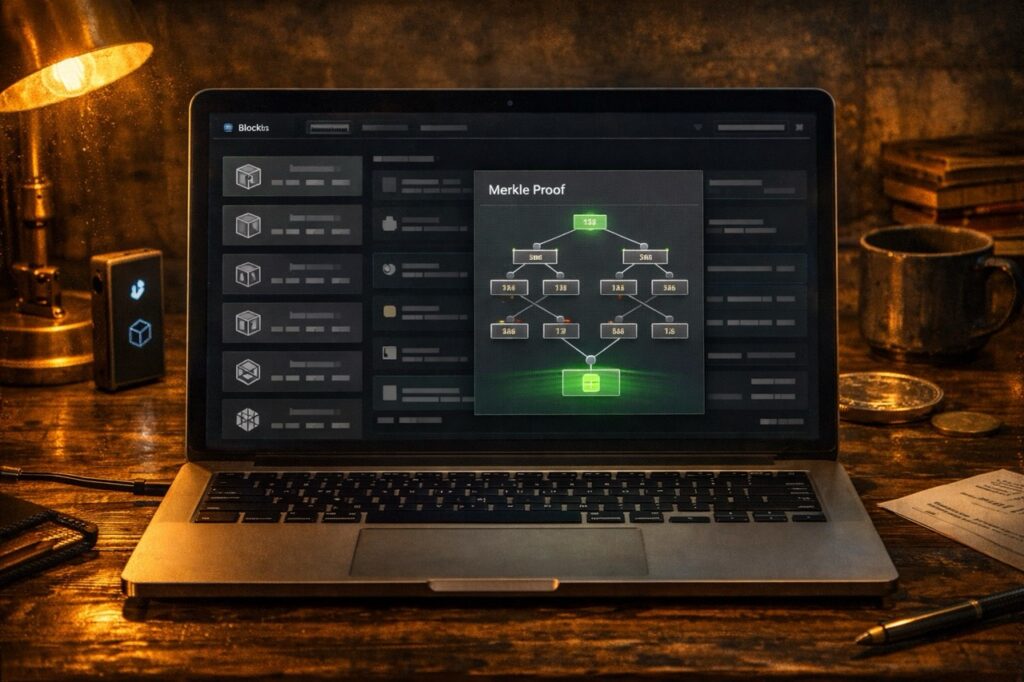
The most important feature is also the least flashy: Merkle proof verification in the browser.
When you click a transaction, the explorer fetches a Merkle proof from the archival node and verifies inclusion client-side. That means the archival node is not a trusted source. It is a convenient source. The proof is the authority. If the node lies, the math fails. This is exactly how it should be. We do not replace one trusted intermediary with another. We replace trust with verification where it matters.
The design also follows a principle that will be controversial to some people: “No surveillance by default.” The explorer is public and transparent, but the wallet does not have to become a tracking tool. We keep the boundary clear: the explorer is for the chain; the wallet is for the user. If you want deep history or indexing, you can connect intentionally to an archival node. Nothing happens silently.
This is not a growth feature. It is a credibility feature. You cannot invite outsiders into a network they cannot independently observe. You cannot build a foundation on “trust me.” The explorer is part of the protocol’s social contract: the chain is visible, verifiable, and understandable by humans, not just machines.
Two weeks from now, the testnet will go public. This is me making sure the public can see it.